William Joseph Mudford (b. 1861, d. 1915)
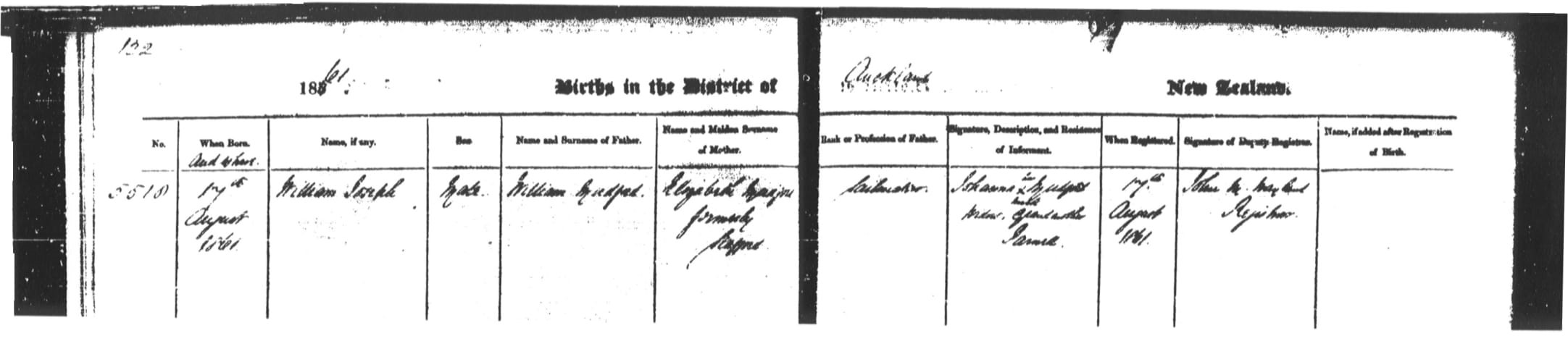
William Joseph Mudford was born in Parnell, Auckland on 17'th August, 1861. The informant for his birth was his grandmother Johanna.
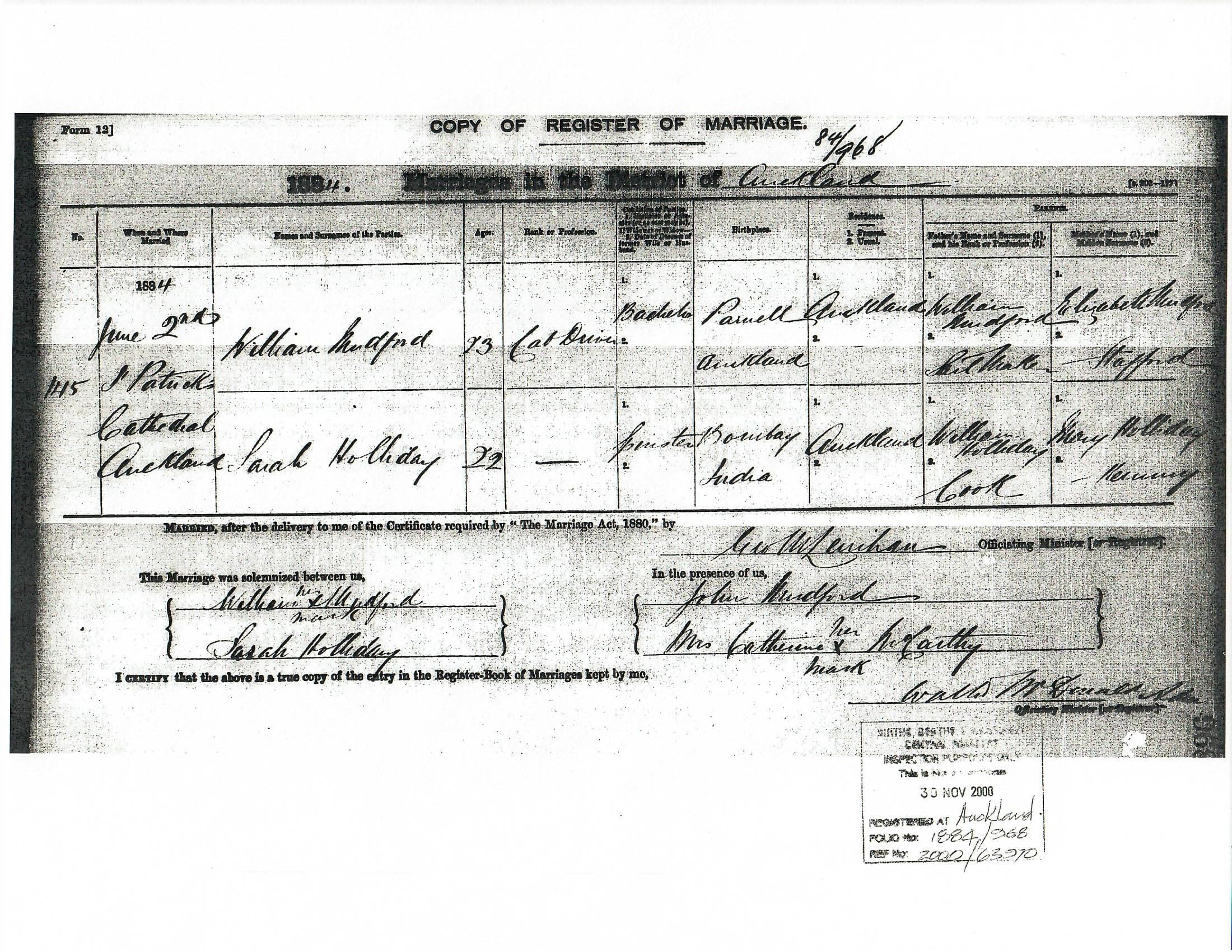
William Joseph married Sarah Rosina Holliday on the 2'nd June 1884. They were married in St. Patrick's Cathederal in Auckland. William possibly had to convert to Catholicism to be married in St. Patrick's Cathedral, however the priest at his burial was Anglican. The witnesses were John Mudford, likely his older brother and a Mrs. Catherine McCarthy. William Mudford signed the register with his mark, whereas Sarah was apparently literate and could sign the register. Interestingly, William's older brother, John, could sign the register, so was also literate to some degree.
William and Sarah had 8 children, all of whom survived to adulthood. These children were, in birth order: Winnifred Violet Mary (Mudford) Leonard (b. 21 Jun. 1885), Sarah Josephine (Mudford) O'Neill (b. 30 May 1887), William John Harold Mudford (b. 16 Jan. 1889), Aileen Elizabeth Gladys (Mudford) McMillan (b. 30 Dec. 1890), Richard Alfred Mudford (b. 24 Mar. 1893), Robert James Patrick Mudford (b. 12 Nov. 1897), William Henry Mudford (b. 24 Apr. 1899) and Jessie Laurimer Cornwall (Mudford) Patch (b. 6 Jun. 1901).

William's occupation was a Hansom cab driver. Hansom cabs were the taxis of their day and were present on Auckland streets until the 1920's. William's younger brother Robert was also a Hansom Cab driver in Auckland. William had a number of very minor run-ins with the police and was apparently given to public obscenity, furious driving of his Hansom cab, on multiple occaisions, and obstructing traffic. At one point William was also charged for not sending a child to school.
From electoral rolls it is known that William was living at Cracroft Street, Parnell in 1899, and Falcon Street, Parnell in 1902.
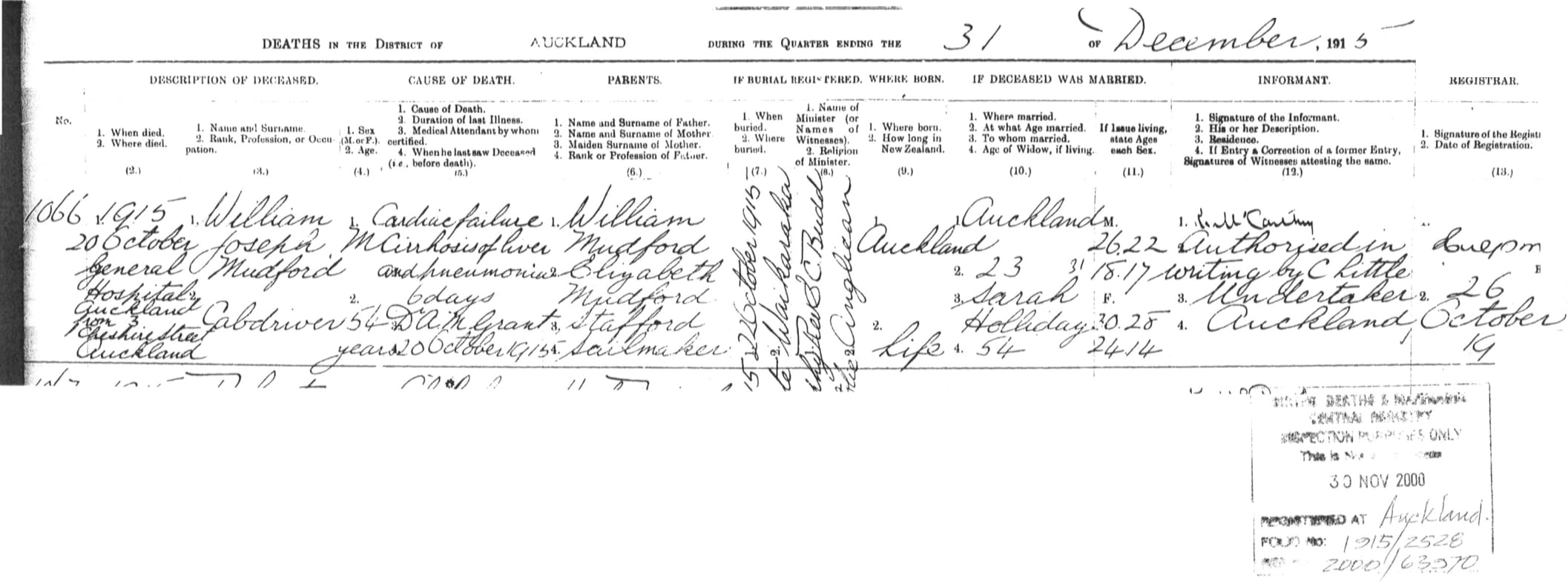
William died on 20 November 1915 at Auckland Hospital. At the time of his death he was living at 3 Cheshire St. in Auckland. He is buried in Waikaraka Cemetery, in a plot which also contains the grave of his wife Sarah Rosina (Holliday) Mudford (b. 1861). The inscription on the headstone reads "In loving memory of William Joseph beloved husband of Sarah Mudford died 20 Oct 1915 aged 54 yrs (verse) Also Sarah his beloved wife died 28 Sept 1937 aged 76 yrs RIP". William also has a profile on Find a Grave.
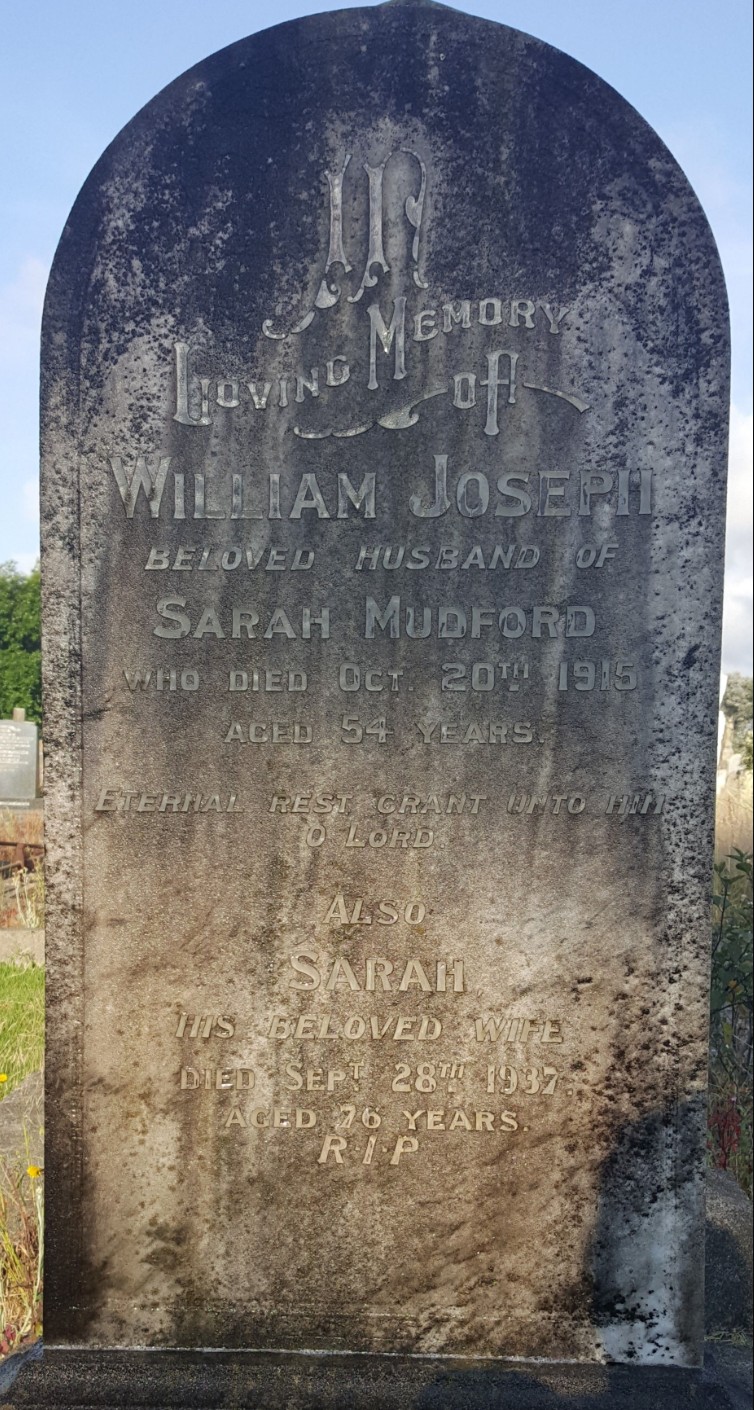
Sarah Rosina (Holliday) Mudford (b. 1861, d. 1937)
Sarah was born in 1861. There are conflicting reports as to whether she was born in Bombay or at sea. During her lifetime Sarah would say she was born in Bombay, and that was how it was reported on her death registration. However, the entry in GRO (General Records Office) Marine Births Indices (1837 to 1965) for British Armed Forces and Overseas Births and Baptisms indicates that Sarah was born at sea. This won't be resolved until a copy of the entry in the Marine Births Indices can be obtained. Her father, William Holliday was a private in the 57'th West Middlesex Regiment, which was deployed to Aotearoa in 1861 to fight in the Taranaki land wars. So Sarah likely arrived in 1861 on board HMS Prince Arthur, which brought many of the families of the 57'th Regiment out to Aotearoa. After arrival in Auckland, the families of the 57'th Regiment were sent to New Plymouth, which was where the 57'th Regiment was headquartered.
In 1869 William was pensioned off from the British Army, and at some point afterwards he volunteered to join the Thames Rifle Rangers. and the family moved to Thames. The early 1870's are somewhat shrouded in mystery for the Holliday family. In January 1872 Sarah and her two younger sisters Mary and Alice were committed to the Auckland Industrial School. The reason given for the committal was that their mother was in jail and their father was in hospital. It seems that their mother Mary was in jail due to being found guilty of using obscene language in a public place, and the sentence was £5 plus costs, or 30 days in jail. The sentencing took place on December 22, 1871. Their father was ordered to provide support once he left hospital. Sarah was committed for three years, and Mary and Alice were committed for four and seven years respectively. The differing lengths of committal seem to be due to the fact that committals were often done for however long it took for the children to reach the age of twelve. Viewing this from the present day, it is hard not to be shocked by a system that sent a mother of three children to prison for the crime of swearing in public, then committed her children for up to seven years under the care of the state when the father had ended up in hospital, and the mother had a period of around a week left to served on her prison sentence!
These committals were part of New Zealand's effort to address the issue of neglected or abandoned children and were thus considered a child welfare initiative which was established under the Neglected and Criminal Children Act of 1867. In September 1873 their father William appeared before the Police Court to explain why he should not contribute to the upkeep of his three daughters, Sarah, Margaret and Alice, who had been in the Auckland Industrial Home for 21 months by that time. There is some potential uncertainty that the newspaper article refers to the Holliday family since William's name is given as William Halliday and his daughters names as Sarah, Margaret and Alice. However, this is likely to be William Holliday and his three daughters, as the timeline fits with testimony given by Sarah to the Māori Land Court in 1908, which will be outlined below. In addition, the sister Margaret referenced in the newpaper report of 1873 is likely to be Mary, since her name registerecd at birth was Mary M Holliday, and also earlier reports referenced above refer to her as Mary Margaret. Additionally, there is a further newspaper article from July 1880, recording the case of a William Holliday who was seeking some recompense for the fact that his daughters Sarah, Mary and Alice were committed to the Auckland Industrial Home as neglected children while he was receiving treatment in Auckland hospital. This is likely the same William as his daughters names are all correct.
During his court appearance in 1873 the Magistrate asked William why he was not contributing to the upkeep of the children. William replied that he had been out of work for a considerable time and was only earning 17s 6d a week and had to pay board and lodging out of that, plus there was the fact that his wife was addicted to drink. He then added that his wife Mary took in washing and earned 5s to 10s per week, plus he had a pension of 1s 2d per day. As a result of all this William was ordered to contribute 7s per week for his children's upkeep in the Industrial Home. It should also be noted that the fine, in lieu of prison time, given to Mary for swearing in public amounted to between 10 and 20 weeks of work for her, which likely explains why she could not pay, and ended up in prison to begin with.
After age 12 many Industrial Home residents were sent out to work. It appears that Sarah was sent to work as a maidservant on a farm in the Waikato owned by a Mr. McGlashan. While at the farm she became involved in a relationship with Tihema Huruhuru who was also at the farm and employed as a manservant. How Tihema ended up at a farm in the Waikato is not known at this point. He appears to have been about the same age as Sarah, but his iwi was based around the town of Waimate in South Canterbury. Tihema was in fact the grandson of Te Huruhuru. As a result of the relationship Sarah became pregnant and in February 1876 she left the McGlashan farm and went to Thames where her parents were living. Her and Tihema's son, Joseph Thomas Huruhuru was born in May 1876 in Thames.
After Tihema's death in 1906, Native Land Court hearings were held to determine the inheritance of his land and assets, since Joseph was his only child and Sarah and Tihema had never married. In Aotearoa at the time this clouded the inheritance for many Pākehā, but not necessarily for Māori. The hearings about Tihema's inheritance were primarily held in Waimate in 1908. However, Sarah gave the following sworn testimony before a Native Land Court sitting in Auckland in 1908:
For the 4 years ending 1876 I and Tihema Huruhuru (known by the English name of William Thomas) were residing as maidservant and manservant at Mr McGlashans station Waikato. While there we cohabited and as a result a son was born. In February 1876 prior to the birth of the son I left the station, and went to my parents at Shortland Thames where the boy was born on 12th May of the same year. This boy has always been called "Joseph Thomas".
Further along in her testimony Sarah states that when Joseph was 13 months old she left him with her parents and went out to service. When Joseph turned 6 years of age Sarah took charge of him again and he lived with her after that. The final Land Court decision was that Joseph should inherit from Tihema as he was Tihema's only child, notwithstanding the fact that his parents had never married. From Sarah's testimony it appears that Tihema wrote to her and Joseph, and sent money on multiple occasions both for her and her parents to provide for Joseph and for Joseph himself. In addition, while Sarah's parents were looking after Joseph in Thames, Tihema visited multiple times. William and Mary's youngest child, Alfred was only born the year before Joseph so he and Joseph would have grown up together until Joseph went back to Sarah at age 6.
Notwithstanding all the time Joseph spent with Sarah and her family William wrote to the Public Petitions Committee of the House of Representatives in 1879 regarding the detention of his daughter Sarah beyond her term of committal. In a newspaper story about the letter it was stated that his eldest daughter was sent to service in the Waikato and detained there against her will beyond the term of her committal and while in service was "debauched by a Maori". Based on Sarah's testimony to the Native Land Court in 1908, this seems to be either William's interpretation of events, or an attempt to garner sympathy, but does not seem to be borne out by Sarah's testimony.
Sarah's testimony to the Native Land Court, Auckland, May 1908
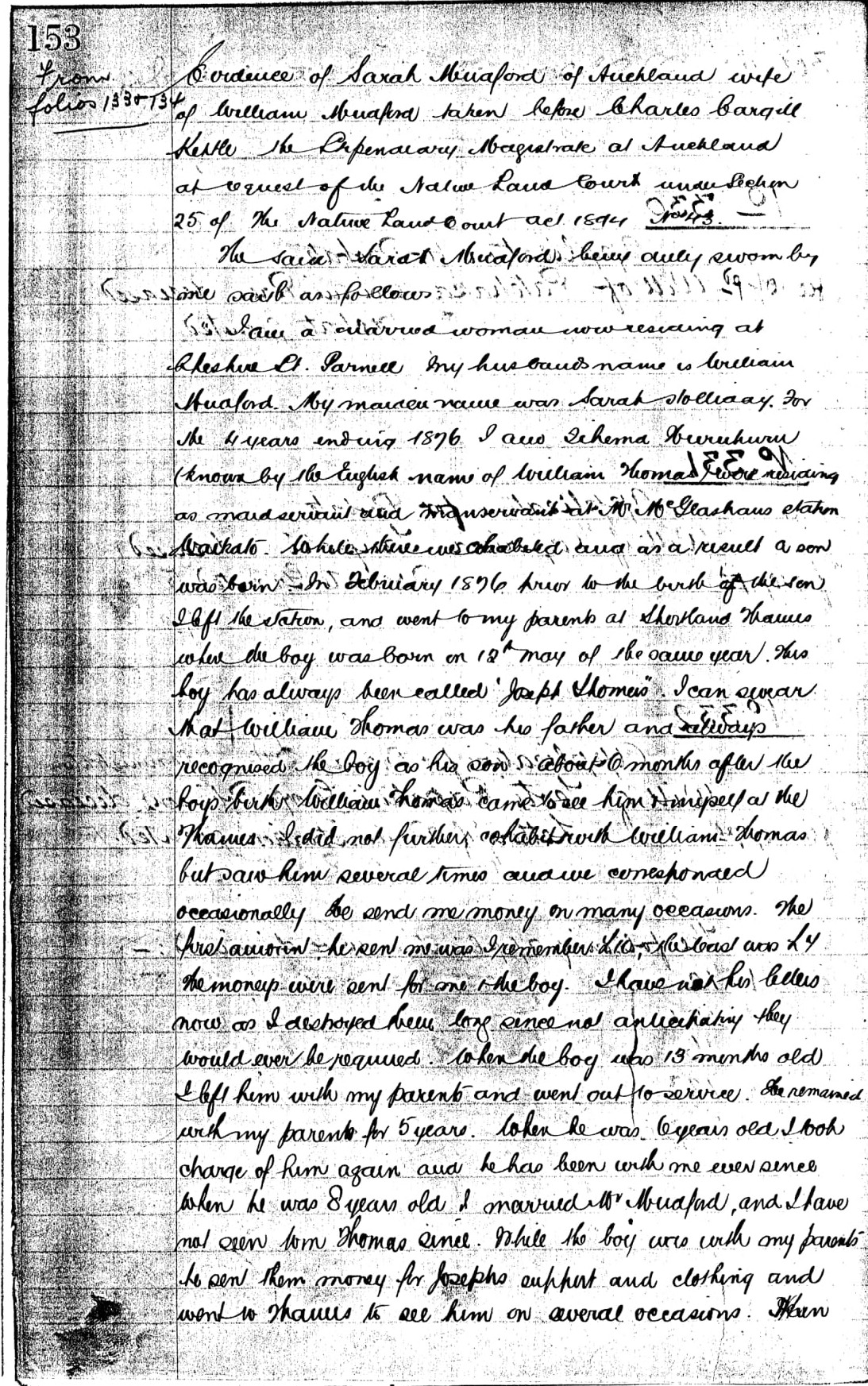
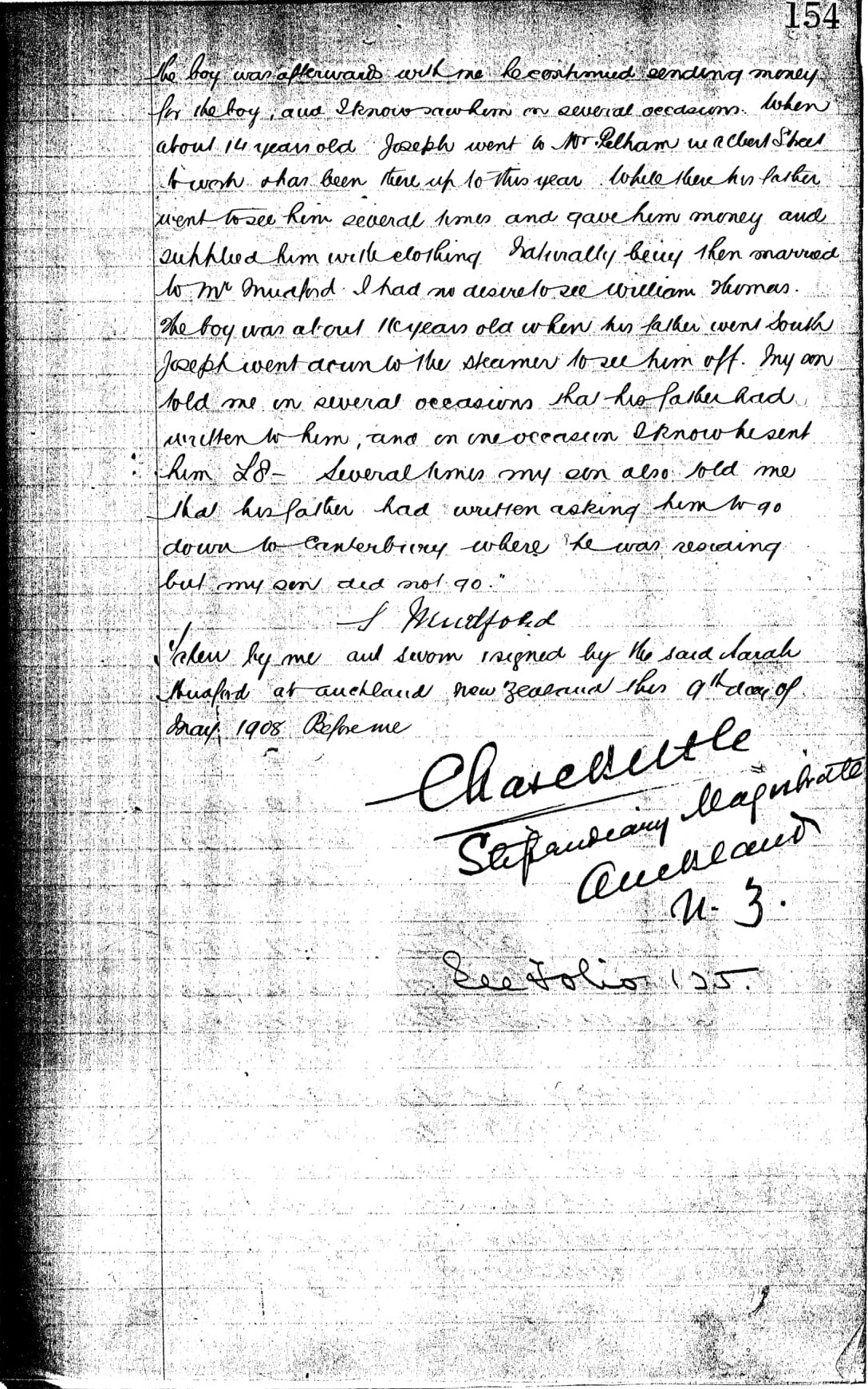
Sarah was a Roman Catholic her whole life. One of the reasons William, her father, had for contacting the court over her and her sister's confinement in the Industrial Home was that they were about to be moved to the Catholic Orphanage. During confinement in an industrial home children were fed and clothed, and had both secular and religious instruction. The religious instruction was either Protestant or Catholic, depending on the child's religion and initially was carried out in the industrial home for both religions. However, around 1873 the Catholic Church petitioned the courts to have Catholic children moved to the Catholic Orphanage. The Holliday girls were about to be moved to the Catholic Orphanage when William appeared before the court to state that although his wife was Catholic, he was a Protestant, and he did not want the girls moved on that basis. Accordingly, they remained in the Industrial Home. Sarah was married in St. Patrick's Catholic Cathederal in Auckland and on her death registration her religion was given as Catholic.
Mudford's at a driver's picnic on Herald Island (then called Pine Island) ~1917, l. to r. Sarah (Holliday) Mudford, Jim Mudford, Sarah (Mudford) O'Neill, Dick Mudford, Esther (O'Neill) Hamilton, Jessie (Mudford) Patch, and Myrtle (Mahon) Mudford.
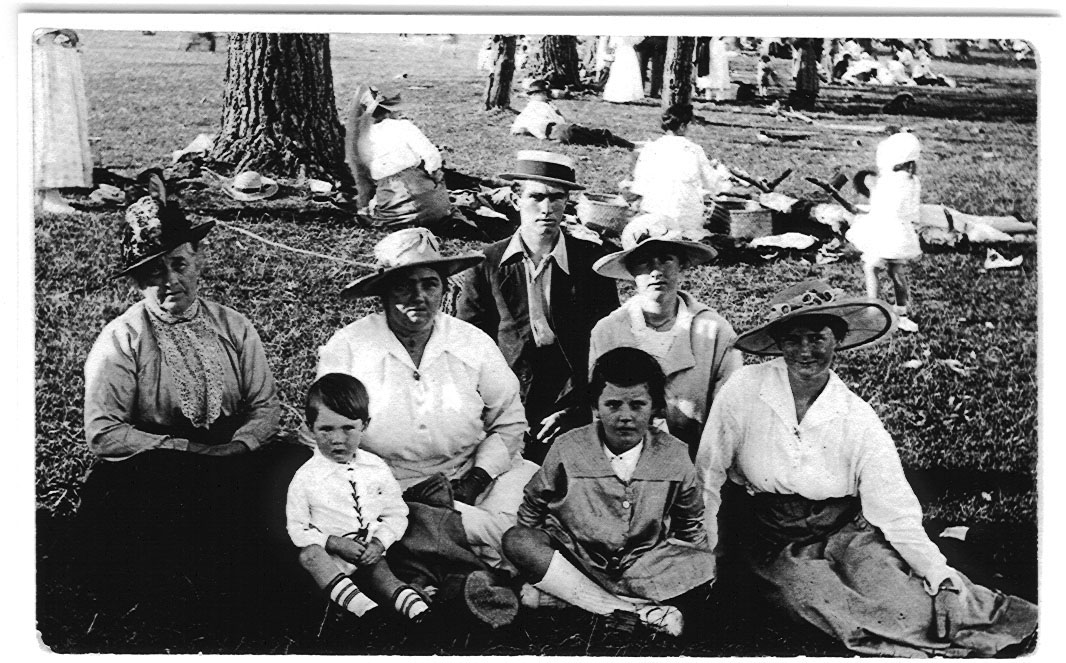
Portrait of Sarah taken in late life
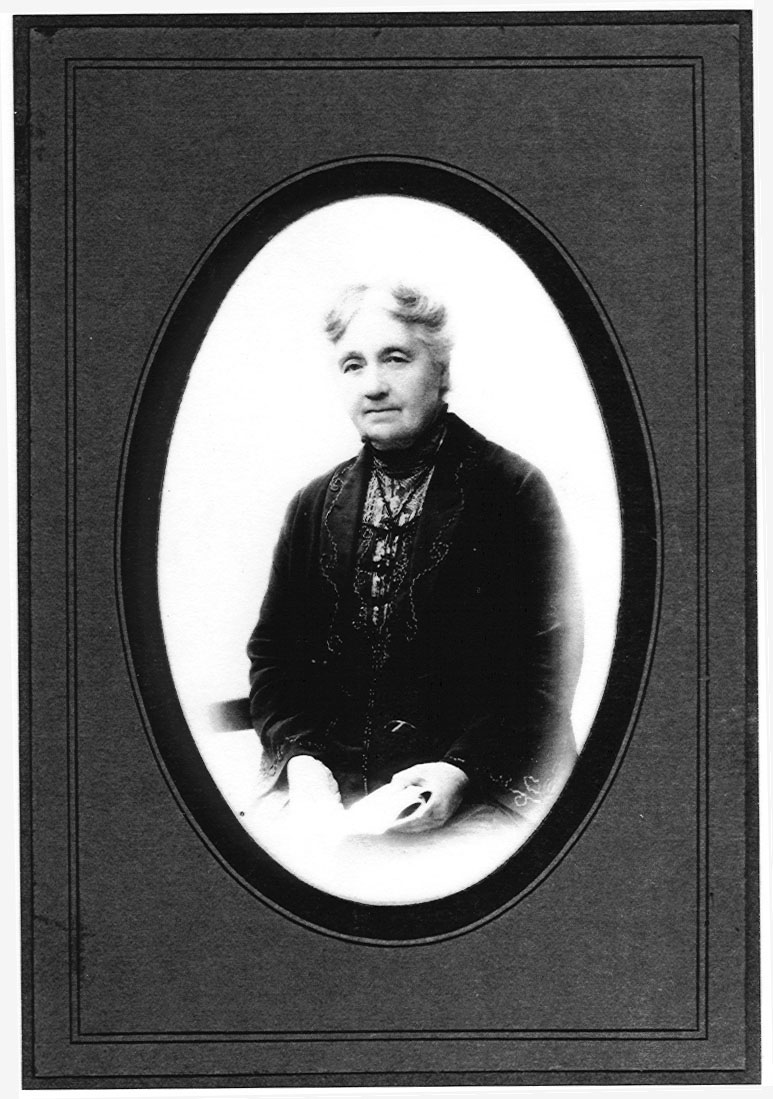
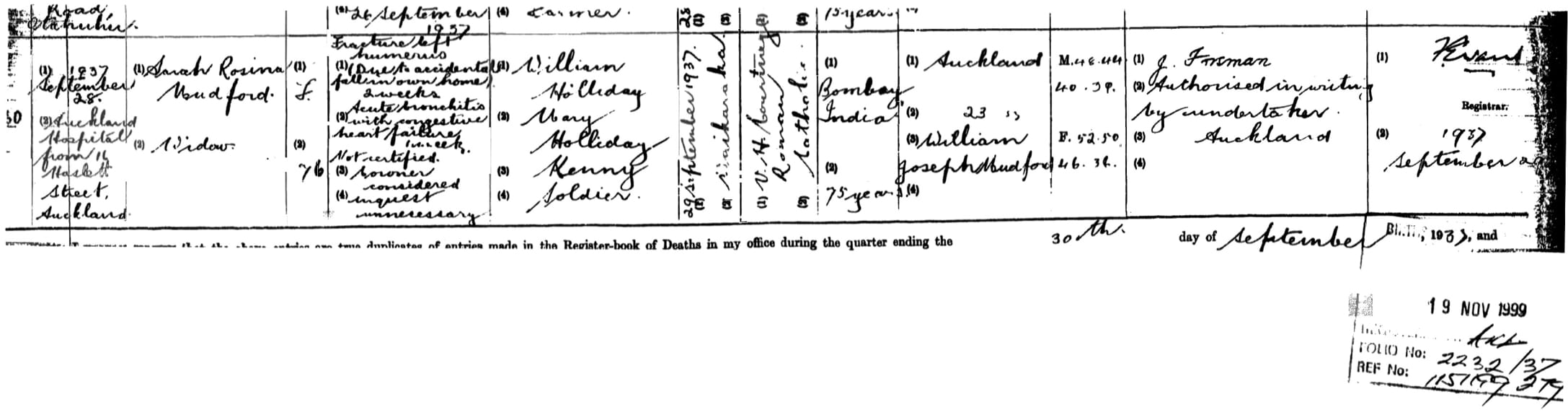
Sarah died in 1937 as a result of a fall in her home on Haslett Street in Auckland. The youngest daughter Jessie had remained living with her mother to look after her. Jessie did not marry until a number of years after Sarah died. Sarah was buried at Waikaraka Cemetery in a plot with William and has a Find a Grave profile.